Deleted or Altered Scenes
Not everything that is written finds its way into a finished book.
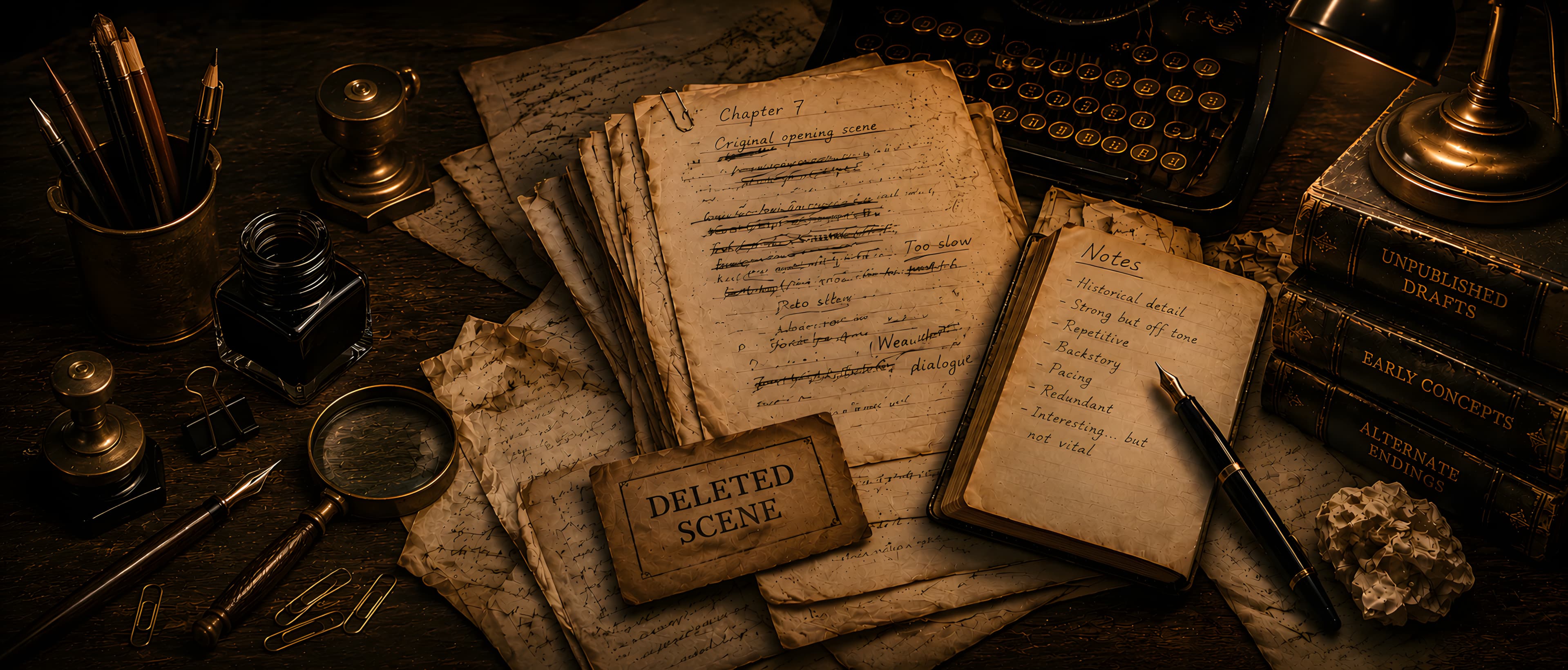
Every novel accumulates material along the way—scenes drafted in good faith, passages carefully constructed, lines that may even be well written, but which ultimately do not serve the story as it stands. Some slow the pace. Some explain too much. Some take the reader in a direction that, while interesting, proves to be a diversion rather than a contribution.
These are set aside.
The process is not a matter of discarding what is poor, but of recognising what no longer belongs, or what slows the pace of the story. A novel demands a certain discipline. It must move with purpose, and anything that disrupts that movement, however appealing in isolation, is removed.
Writers often refer to this as the “cutting room floor”—a term borrowed from film, where scenes are edited out to preserve the integrity of the whole. What remains unseen can be as important as what is left in place.
From time to time, it is possible to revisit some of this material. A deleted scene may offer a different perspective, a fragment of character, or a moment that, while not essential to the narrative, still holds interest.
There are limits, however.
In a story grounded in real events, particularly one that draws upon historical uncertainty, some omissions are deliberate and must remain so. To include certain scenes — even in isolation — would reveal too much, or fix in the reader’s mind an interpretation that the novel itself leaves open.
What follows, therefore, is a selection rather than a complete record.
These are pieces that illuminate the process without undermining the story that emerged from it.
The Original opening of Chapter 1
The chapter below is the opening with which I originally began writing Blackest of Lies. During the editorial review it became clear that, although it established the world well, it delayed the introduction of the central mystery for too long. I therefore rewrote the opening almost completely, bringing Christopher Hubert and Anne Banfield into the story sooner and increasing the pace from the very first pages. The published novel now begins quite differently, but this earlier version remains, I hope, an interesting glimpse into how the story evolved.
Saturday 20 May 1916 0900 hours – 1700 hours
Hubert jerked sharply awake to find himself still in the familiar surroundings of his quiet Whitehall office, far removed from the incessant turmoil of the Front. For a brief moment, he looked around uncomprehendingly and then leaned gingerly back in his chair, sweating, as he realised he was not gasping his last in the glutinous mud of the Ypres Salient. Flashbacks were likely to remain part of his life, at least for a while – ‘just the mind struggling to come to terms with memory,’ they had said but this was the first time for a few months and it was a shock he could happily have done without. He had a long way to go, evidently. Standing uncertainly up, he made his way into the little washroom, unpinned his uniform shirt collar and washed the sweat off his face.
“Big girl,” he growled, glancing at his pale reflection in the mirror.
Sleep-walking back into the tiny office, he kicked a few empty cardboard packing boxes aside, sat back down heavily into the elderly, standard-issue War Ministry chair and breathed deeply. The memory of being partially buried in a trench mudslide and then helplessly gassed was something he wasn’t going to shrug off any time soon.
Looking up at the sound of a tentative knock on the door, he smiled at the sight of the girl peering around it. It was Kathleen Sissmore, a pretty 18-year old clerk who had just joined MI5 and was, unaccountably, called Jane by everyone. “You didn’t sound too good there, Chris. Do you need me to get the doc?”
Hubert smiled in spite of himself – she really was very sweet to worry – her painfully upper-class English accent always brought out the colonial in him. It seemed that all the secretaries and most of the Registry girls were somehow related to officers of the Army or Navy and had backgrounds similar to Jane’s as a result. That was how MI5 worked – word of mouth, a whisper in the ear and suddenly a post would be filled. In his more sardonic moments, he would sneer at it as ‘enlightened nepotism’ but it did seem to work. He, for one, could hardly complain. If it hadn’t been for his father using his influence to lobby the High Commission back home in Canada, he’d have been invalided out of uniform at the end of last year. Instead, here he was – working for MI5 in London as some sort of high level dogsbody. That’s what he liked to tell himself. In fact, he was a key member of Section G(a) – the department charged with the investigation of espionage and suspected persons.
“No, I’m fine, Jane. Don’t cluck around me.” He beamed at her to remove any offence.
“You’ve come back to work too soon, Chris. Yes, I know,” she said archly, holding up her hand to forestall his reply, “you’d have been sent back home to manage your father’s hotels and what-not. You would have been driven round the bend in no time.” She smiled sadly, “But that would have been better than slowly gasping your last in London.”
“The fact is – I just hate them, Jane,” he sighed wearily.
“Hate them – who?”
“Who? The Hun. Who else?” He sat back, brooding for a moment, and then grinned at her. “It’s difficult for you English roses to understand.” She dropped a stage-curtsey. “But people like my lot are sort of Gallic mongrels. I’m part French-Swiss and part French-Canadian. Both sides of me hate what they’re doing in France and Belgium. That’s why I dropped out of Business School in Toronto the minute the balloon went up.” He chuckled briefly at the memory. “My old man was mad as a snake. God, was he mad!”
“Whereas now you’re twenty-four years old and your lungs are so badly damaged you can’t walk up a flight of steps without collapsing. You’ve done enough, Chris.”
He snorted briefly. “Well, I clung to life at Pops. Now I’m clinging to my uniform. Anyway – look at Kell. He’s Director of all he surveys and he’s asthmatic as a vicar’s wife.”
“Pops?”
“Sorry – Poperinghe – the casualty clearing station outside Ypres. That’s where most of us ended up. I had an engaging couple of weeks there before being shipped back.”
“Chris,” she murmured. The phone rang in her office, breaking the silence, and she disappeared back behind the door to answer it. “Chris,” she called, “Kell wants you to go down and collect Thompson from the Front Desk.”
***
Two offices along from Hubert, Major Vernon Kell, Head of MI5, scratched away industriously with a small, silver-handled pen at his notes of the assassination. His office was already stuffy as a result of the warm May morning yet all the windows of his office, just off the Strand, were closed. A fastidious man, Kell hated anything untidy or out of place and that included open windows and fluttering curtains. The muffled noise of the London weekend traffic barely penetrated the sanctum of Kell’s empire – only the rumble of the large, horsedrawn omnibuses succeeded to any degree.
The room itself was a triumph of minimalism. Apart from the massive Victorian desk, there were only three chairs and a filing cabinet to spoil its simplicity. An oaken wall clock behind him ticked sonorously away, wearily doling out the seconds as if each were precious.
A stifled sigh stopped Kell in mid-scratch and caused him to look up petulantly at the other occupant of the room – an officer in his late fifties, immaculately uniformed and sporting a large black moustache. Lieutenant Colonel Oliver Fitzgerald was – had been – Kitchener's personal staff officer. He had been at his side for many years – since India, in fact. All over, now. Kell had called him at his London apartment an hour ago and summoned him over. The news had rocked Fitzgerald back on his heels – especially the fact that the IRB was strongly suspected of the murder. No doubt His Lordship would have found that amusing – born in Ireland and then murdered by her sons.
He brushed fastidiously at his spotless trousers, looked across at Kell and let his frustration finally boil over. "Kell, when can we expect Thompson? We have to move quickly on this business. The very Devil will break loose when the news becomes public."
Kell had already returned to his single-minded scratching and winced mentally at the further distraction. "As I said earlier, sir, he is dealing with matters related to the problem. Mr Thompson is briefing the Prime Minister and will relay his wishes to us when he arrives."
Fitzgerald sighed again and gazed distractedly out of the window at the unappealing Saturday morning view of the park and the Thames beyond. A small puffer was smearing its way downstream, leaving a short wake behind and a long memory in the sky. Kell was a cold fish. He wondered if the magnitude of what had happened today had really sunk in behind those unblinking eyes of his. Vaguely disappointed, he realised that it probably had. But, then, he was not prepared to lose patience in front of people like Kell. “And another thing - there seem to be a large number of boxes around your various offices, Kell. I noticed them on my way in. You do not strike me as the type of officer to permit this kind of laxity. Can’t you have them stowed away somewhere? I dread to think of the impression it gives to civilians.”
Kell glanced up for a moment, without interrupting his writing. “I apologise if it disturbs you, Sir. Once again, my department has outgrown its quarters. We are in the process of moving to new premises in the Haymarket area. The relocation takes place next month but we have a huge amount of documentation to move, particularly when it comes to the Registry. It is a distraction we could have done without in the light of current events but we need the space.”
“Well, I am not trying to tell you how to run your own Department but all I can say is that His Lordship would have had something to say about it – and it would have been short and to the point.”
***
Hubert pulled the lift doors open and stood aside for Thompson to get out. The older man stood motionless, eyes overflowing, and took a deep, hesitant breath before clearly changing his mind and muttering “Damn!” Hubert led him along the carpeted corridor of anonymous doors until he reached Kell’s outer office where he handed him over to Jane’s tender mercies. She removed Thompson’s overcoat.
“I’ll just step into the washroom for a moment”, said Thompson and wandered lugubriously off.
Hubert sat on the edge of Jane’s desk. “So that’s the Head of Special Branch, is it? Know him well?”
“Not particularly. But he’s been around the block a bit.” She leaned forward conspiratorially. “He was actually the Prime Minister of Tonga at one point! Can you believe it?”
“You’re kidding me – right?”
“No, I swear…”
Thompson re-appeared and Hubert stood up, more or less at attention. “Right, Sir, let me take you through.” He knocked firmly on the inner door and, without waiting for an answer, walked in.
"Yes, Hubert?” said Kell.
"Assistant Commissioner Thompson, Sir."
"Very well. Show him ...” He looked narrowly at Hubert. “Are you quite all right, Hubert? You look dreadful.”
Hubert managed a wan smile. “No, sir, I’m fine.” The last thing Hubert was going to do was to let Kell think that he was not up to the demands of the job. Kell would have him counting cartridges in Aldershot within the week if he betrayed any suspicion that he wasn’t fit for duty. But apart from that, he’d be damned if he’d let him think it.
Kell grunted in disbelief. Thompson, walking past the younger man into the main office, croaked “No, you don’t – you look worse than I feel.”
“Thompson,” said Kell in greeting, “Dreadful business this. Take a seat.”
Fitzgerald was staring at his watch with a puzzled frown. “Your clock correct, Kell?”
Kell glanced at the clock and then Fitzgerald. “It is, Colonel, but perhaps you have forgotten to put your watch forward one hour. Our new British Summer Time starts today, if you recall.”
“Idiotic idea,” snorted Fitzgerald as he adjusted his watch.
“I believe the idea is to reduce coal consumption.”
“God knows the chaos it’ll cause.”
“May I introduce Assistant Commissioner Basil Thompson, Head of Special Branch?”
Fitzgerald coldly looked over the elderly-looking man in his mid-sixties, dressed in a dark, formal suit and wing collar. “Special Branch,” he intoned. He made no move to offer his hand.
Hubert stood at the door for a moment to watch the fun. Everyone knew that there was no love lost between Thompson and the remote Kell. Even worse, their respective departments often had to work hand in glove – particularly in counter-espionage. Hubert and his colleagues in MI5(g)A did the actual tracking down of spies on British soil but they had no power of arrest. That's where Special Branch came in, bringing with it the inevitable, and generally-held feeling, that MI5 did the spadework while Special Branch picked up all the plaudits, particularly Thompson. It didn't make for an easy alliance.
Thompson nodded curtly in the general direction of Kell and Fitzgerald and sat ponderously down in one the leather armchairs. He sneezed violently into a garishly coloured handkerchief. "Damn cold,” he mumbled. “Sorry I’m late. Traffic is jammed around Whitehall – huge Covent Garden wagon overturned. One of the horses stuck underneath it. It took me nearly half an hour to get a Hansom and, even then, we had to go the long way around.”
While Thompson dragged his papers from a thick, ciphered briefcase, Hubert had a quick glance around the round and tried to guess what could possibly be going down to get this collection of egos into the same room at the same time. As a Canadian, the inter-departmental politics of the British Government had always been a complete and impenetrable mystery to him and he was happy that it should remain so – not that he had any patience with it – it was just a force to be observed wryly but treated with respect. These three would undoubtedly bore him rigid and, the way he was feeling right now, he had every intention of sloping off outside for a few minutes to get some fresh air.
"Stay in on this one, Hubert,” said Kell as he made to leave.
Hubert cursed internally.
"Gentlemen, this is Lieutenant Christophe Hubert, late of the Canadians – Princess Patricia’s Light Infantry. He has only been with us for a few weeks but, as you know, I am spread very thin at present in terms of manpower. I am taking personal charge of this calamity and I’ve borrowed Hubert from my second-in-command, Holt-Wilson, to be my assistant during the investigation."
Hubert sat down in the third chair, working over Kell's introduction in his mind to see if it came to a compliment of any sort.
Fitzgerald looked long and hard at Hubert, observing the transparent pallor of a soldier who had suffered the horrifying experience of chlorine gas. It was unmistakable.
"Belgium, Hubert?” asked Fitzgerald, quietly.
"Ypres, sir.” He had no intention of going into details. Whoever said that time was a healer clearly hadn’t served in the trenches up to his eyeballs in filth. For Hubert, the noise, the crying, the gas were all too recent to be casually discussed in a quiet office beside the Thames where paper cuts were about as far as injuries went. Oddly enough, he sensed that Fitzgerald had no desire to talk it over either; something he had noticed in senior officers who had never experienced trench warfare at close quarters – a strange sort of shame at being miles away from a type of conflict they just didn’t understand.
He suppressed a cough that threatened to send him into another racking fit. ‘Dry land drowning’, it was called – the effects of chlorine gassing – where the walls of the lungs, stripped of their linings, wept fluids which caused the violent coughs and clawing for air. He hated the weakness it brought and the knowledge that his life was inevitably shortened. Exactly how long he had was anyone’s guess, but one thing was for sure – he wouldn’t be seeing any telegrams from the King.
By now Kell had visibly closed off that portion of his mind given over to trivia such as junior officers. "Mr Thompson,” he intoned gently, clasping his hands together on the blotter, "kindly give a résumé of events for the benefit of Lieutenant Hubert."
Hubert looked at Kell, thought ‘bloody school teacher’ and turned to meet the bleary, red-rimmed eyes of the older man. Thompson wiped his large, mottled nose and began.
"Early this morning, Lord Kitchener's valet found him dead in his bedroom down at Broome. His Lordship had been shot four times at close range. We’re still working on the bullets but they're probably from a Mauser, possibly silenced. Indications so far point to the IRB."
Hubert sat in silence for a moment, letting the appalling news sink in. His first reaction was one of simple disbelief. They very idea that anyone in Britain would want to kill the driving force behind the war effort was lunacy. "The Irish! For God's sake... why?" he asked, stunned by thought.
Fitzgerald cleared his throat. "There are a number of possible reasons but recently Lord Kitchener received a request, through the usual channels, from the Irish regiments at the Front for permission to wear the symbol of the harp on their tunics. For whatever reason, His Lordship refused the request."
"This,” continued Thompson, "upset our Hibernian brothers and the IRA used the matter as the excuse they needed to issue a death warrant. Personally, I think they were motivated more by the thought of British troops back in Ireland after the War. Be that as it may, we set ourselves to watching one or two promising Murphies but, as you can see, we were caught with our trousers round our ankles. To be fair, it also has to be said that Lord Kitchener had many enemies in Government circles, some of whom were very powerful indeed and you can believe me when I say that this is a line we are not neglecting.”
“Anything to do with Casement and his supporters?” prompted Chris.
“Well, that’s certainly one aspect. We hope to bring him to trial soon and, as an Irish rebel in league with Germany, he’ll surely hang. But there are key members of our own Government who were, shall we say, less than enamoured with Lord Kitchener and who are not beyond the odd, seriously dirty trick. I can’t say any more than that at the moment but, at any rate, we’ve had a number of men constantly on duty at Broome with the clear duty of protection. I will be looking into their abysmal failure, too. I have just come from the office of the Prime Minister. You can imagine his reaction when I gave him the news. This is the worst thing that could have happened to us.”
“Worst time, too,” muttered Fitzgerald.
“Quite. The PM wishes us, indeed his explicit instructions are, to do everything in our power to repress the news for as long as it takes us to come up with a plan of action. We are to take any actions – any – which will minimise damage to the country and the war effort. 'All resources, all solutions, without restriction' are ours to command – his words. And that, as far as it goes, is the current state of this bag of nails we have on our hands.”
Thompson looked across at Kell. "Personally, I need to get down to Broome for some first-hand work before I can make any decisions. You’re welcome to tag along, too, Kell."
Hubert, despite being less familiar with Kell than Thompson was, saw the storm coming over the horizon and felt like clapping a tin hat on. Kell had resumed his writing during the conversation and put down his pen deliberately, to form an exact angle to the blotter. He arranged his papers neatly before clasping his hands before him once again. "I will remind you of this only once, Commissioner – I, too, have a remit to care for the internal security of this country. I will not merely tag along, as you quaintly express it. I will be at the centre of things and you will make no unilateral decisions without my complete agreement. If you cannot accept this right from the outset, we will have to visit the PM and sort the matter out.”
Thompson said nothing but his face told volumes. Taking the awkward silence as agreement, Kell continued, “One thing only is certain in this dreadful mess. The knowledge that this might have been the work of the IRA must, at all costs, be withheld from the public – not only now, but permanently. Quite how we will achieve that, I have yet to decide. We need time. Time to work out some sort of strategy – a cover story of a heart attack or something of that nature brought on by overwork. He was in his late sixties, after all. Anything which will take him out of public view immediately and for good."
Fitzgerald blinked rapidly and plucked again at some imaginary threads on his uniform. "I am not sure I entirely approve of your referring to Lord Kitchener as though he were a stone in your shoe, Kell,” he barked, irritated by other's dispassionate manner. "This is the man who built our Empire. The Hero of Omdurman. He was a great soldier, perhaps our greatest ever, and a great man, too. None of us were fit to bull his boots. You seem to be in great danger of forgetting that. He is dead because of the incompetence of those set to watch over him." He looked significantly over at Thompson.
"I meant nothing of the sort, Colonel,” replied Kell, coolly, "nor do I accept any charge of culpability in this matter, since Special Branch – and not my department – was tasked with his safety but it is my unfortunate responsibility to ensure that the damage caused by Lord Kitchener's death is somehow deflected from harming our Country's interests. He would not wish his demise to bring us down, particularly in these dire straits. We are losing thousands of our youngest and fittest men at the Front each and every day. The Russians are melting away like last winter's snow because of incompetence and corruption at the highest levels within their General Staff and the French are as hopeless as usual. Just as important, public opinion at home is very mixed, indeed, as regards the war. You, at the War Office, may be in touch with the ebb and flow of the conflict itself but you are sheltered from the harsh realities of what it's doing to the British public. Commissioner Thompson and I grapple daily with traitors and spies and malcontents of all sorts and stations. I dread to think how the man in the street will react to the news that Lord Kitchener has been gunned down in cold blood by citizens of the islands.”
Kell sat back in his chair. "We rely on our families at home to support our troops in France. We need our ammunition and our farm produce and even the knitted balaclavas and the personal things which tell our men that their loved ones are thinking of them. If civilian morale drops further, we can pack up and surrender to the Kaiser without further ado. I regret His Lordship's passing – truly, I do. As you say, he was a great man but we have higher priorities now."
Fitzgerald sniffed disdainfully and sat back in his seat. "I need no lectures concerning the War effort from you, Major.”
Hubert pursed his lips a little and stared into space. Kell had it right. This was a bloody disaster. The war, pretty much, was over. There was no-one with Kitchener’s grasp of the current military situation to slip in and save the day – no-one of his stature, even. What made it worse was the fact that it was also very unusual to have a serving military officer holding the government portfolio for War. It was highly unlikely that someone from the General Staff could carry the torch without fumbling it. He remembered, still with a tinge of disbelief, the first time he was told that even though Kitchener held the most important brief in wartime Britain, he couldn’t even speak in the House because he was unelected. That had to be done by his Under-Secretary – a ludicrous state of affairs but, right from the start, the King and the Prime Minister wanted him and no-one else. Now he was dead. The thought that Germany might actually win simply because this would sink British morale too low to be resurrected…
Thompson blew his nose, loudly, bringing Hubert sharply back to reality. "Nor do I need you, Kell, to labour the point that my men slipped up. I will deal with that later, as I have already made clear. But, look here, we're in danger of drifting from the point, which is to decide what, in God’s name, to do next." He turned ponderously round in his armchair. "Hubert, you are new to this – a fresh eye, perhaps. What’s your initial reaction?"
From the corner of his eye, Hubert could see Kell glare at Thompson's impertinence. He smiled inwardly but, yet, with a touch of irritation. Clearly, as a very junior officer, he would have nothing of value to contribute in Kell’s eyes. Then again, Kell had not served in this conflict whereas Hubert knew how the men, particularly the younger ones, worshipped Kitchener. He had seen how shared experience in that sort of incessant misery simultaneously polarised and magnified the group perception of an individual’s attributes. A man was a ‘great hero’ or a ‘miserable coward’ – rarely anything in between. Kitchener’s posters and photographs were everywhere, sternly pointing out their duty. It was inevitable that he would be proclaimed a demi-god by those serving under him – but could he really have been murdered by the Irish? "It goes without saying that we cannot let English troops know that Kitchener was killed by the IRB – if that is, indeed, the case,” he replied.
Thompson smiled ruefully and nodded agreement. Nothing had been proven yet. Hubert pressed further. "I'm of Swiss-Canadian parentage so, to a certain extent, I think I can view Anglo-Irish relations from something of a distance but, even that being the case, I have absolutely no doubt in my mind that we would have internecine war in the trenches if this came out – English regiments against the Irish. You must realise that Kitchener was like a God to the British Army.”
“He was, of course, very popular but don't you think you might be overstating the case?”
Hubert turned to face Thompson and cast his mind back to the carnage he had left behind at Ypres. “Let me see if I can put this into perspective for you, then, Sir. When the mud had set on the Ypres Salient after one of the larger pushes, the Red Cross were trying to identify some of our boys who had died on the field. They came across a young lad – probably should still have been at school – but there he was, lying face down in the mire of an empty trench. His only company was a couple of mutilated horses that had been blown in by the blast of a shell. In one hand he had his empty Enfield and, in the other, a crumpled, blood-stained photograph of Lord Kitchener, torn from a magazine.” He paused and smiled sardonically at the others. “No more than a boy, I agree, and probably very impressionable but men grow up quickly over there, Commissioner. It's either that or not growing up ever. Clearly, this lad had worshipped Kitchener – and he wouldn’t have been the only one – so, one sniff of this business and all Hell will break loose. We'll lose the War within the week."
"Point taken but do you really think things would go that quickly?” asked Thompson.
"I do. And it's for that reason that I can't really take this idea of the Irish being involved. Surely it can't be in their own interests to allow the Hun to win the War? I mean, Ireland would fall with Britain. How can you be so sure they're behind this?"
"One name,” replied Thompson, heavily, "Gallagher. We had reports that he was seen in London recently. As usual, he slipped our net and disappeared God knows where. Now, perhaps, we know. But you’re wrong if you feel that an English defeat wouldn’t serve the Irish cause. We have strong evidence that the IRB have been in close talks with the Hun over who gets what after Britannia sinks below the waves."
"Who is this 'Gallagher'?" asked Fitzgerald.
"An IRA assassin – their best – very good and very slippery,” said Kell. “Usually works alone. Commissioner Thompson and his staff have long chased him the length and breadth of the British Isles but he always manages to stay one step ahead of them.” Thompson shifted irritably in his seat but held his tongue. "If he is involved, we shall have an uphill job of it.”
"He's an odd character,” mused Thompson. "Sound Catholic background. Well educated, too, within the constraints of his opportunities, but lethal – something went wrong inside him. He’s cold as ice when it matters and utterly careless of life – anyone’s, including his own. Speed the day when we can put him to rest. At any rate, his appearance on English soil at this particular moment is too significant to be mere chance. The IRA are not known to waste his talents – although it is rumoured there’s some rough and tumble going on at their Dublin Brigade HQ. One or two of his colleagues-in-arms are less than happy about his way of picking and choosing which missions he will take on – and deciding how he’ll do things when he does. But that's beside the point.” He shifted arthritically in his seat. “What is to the point is the fact that the Mauser is his preferred weapon. A little bulky but you can be assured that when you pull the trigger, anything in front of the business end is going to feel terminally unwell. And the clincher, I suppose, is that we simply have nothing on the Hun espionage front to suggest enemy involvement – they're all quietly playing with their sketchbooks and cameras.” He chuckled quietly and wiped his nose. “Well, the ones we didn’t sweep up on Day One of the War, that is.”
“I’ll bet that pleased the Kaiser,” said Hubert.
Thompson chuckled quietly, “It did that. Apparently, he raved for the best part of two hours when he heard the news. Steinhauer must have had his ears reamed out.” Seeing Hubert’s eyebrows raised in question, he added, “Steinhauer’s Major Kell’s opposite number.”
Kell tapped his pen irritably. "I have to say that all this concentrates on the crime itself. To some extent, it is even irrelevant. There are difficulties at the other end, as it were, that we must consider. The direction of the War cannot be allowed just to drift along with the current. Someone will have to be appointed to replace him – and soon. This brings us back to the original question of how we are to announce his ‘retirement’ to the nation. That is perhaps of greater importance than the crime itself. We have no more than a few days to play with, gentlemen."
Thompson looked over at Fitzgerald. "Colonel,” he said, "We must rely very heavily on you this week. As a stop gap, I suggest you notify the War Office that Lord Kitchener has contracted a mild case of flu, or something. He'll need, let’s say, a week to recover."
"Impossible,” snorted Fitzgerald. "His Lordship would never absent himself from the office for that length of time. Sooner or later, some essential document would need to be signed or a report read and commented upon. Down would come someone to Broome and the game would be up.” He paused and looked at Kell and Thompson. "Three days. That's all you can hope for."
A Deleted Scene: Kitchener's Salary Debate
One episode that almost found its way into Blackest of Lies was the debate in the House of Commons concerning Lord Kitchener's salary. The discussion actually took place and is recorded in Hansard. In the original manuscript I adapted the proceedings into a dramatic scene to illustrate the political pressures under which Kitchener was operating during the spring of 1916.
In the end, however, I removed it. Although historically accurate, it interrupted the momentum of the story and delayed the investigation. The scene worked better as history than as thriller.
The House of Commons – 31 May 1916
The vultures were gathering in the House of Commons. The Committee on Supply was holding its sixth day of debate and Tennant, the Under-Secretary of State for War, had obligingly dropped the hint about Kitchener’s willingness to see all comers at the War Office. So far, no one appeared to have caught on but there was a restless atmosphere about the chamber, as if a storm were about to break.
Churchill had just spoken about funding difficulties – the ‘Vote’ – in relation to the production of war supplies when General Sir Ivor Herbert, Member for South Monmouthshire stood up. His was to be the opening shot.
“Mr Speaker,” he intoned richly, “I beg to reduce the Army Vote by £100 in respect of the salary of the Secretary for State for War!”
A grumble ran around the Chamber. There were a number of malcontents present, happy to see Kitchener taken down a peg or two – and this was the time-honoured way of doing it – but mixed among them were genuine admirers.
“Anyone who has listened to the powerful, well-argued, well-informed speech of the Right Honourable and Gallant Gentleman,” he continued, pointing to Churchill, “will not be surprised that there should be a wish in this House to express by the usual Constitutional method, a certain amount of doubt in the management of the great department presided over by Lord Kitchener”. He looked around, benignly, revelling in the supreme moment of an otherwise mediocre Parliamentary career.
Tennant glared at him from across the House.
Herbert puffed himself up a degree further and launched another mock-sad tirade. “I do not wish to question the services which Lord Kitchener has rendered in the past. I am merely concerned with the apparent lack of any overall scheme to the raising of troops. First we were told that we needed ‘up to thirty divisions’ yet my Right Honourable Friend now shows that we have seventy. Are we to look to one hundred? A limit must be set or we will be unable to develop the necessary organisation to control these sorts of troop levels.”
***
It was evident that Herbert, awed by his own eloquence, was prepared to continue the attack but Asquith, concerned not to allow the opposition time to gather their courage by mobbing together, had other ideas. “Time to prick this balloon,” he thought. He stood up, forcing Herbert to sit, and reminded the House of Kitchener’s monumental contribution to the Empire. He looked around to satisfy himself that he had the attention of all those present but, particularly, he was looking for any sign of that toad Lloyd George. Not surprisingly, he had made himself scarce, having sown the seeds for lesser mortals to reap. Asquith could see Herbert itching to get up on his hind legs again and forestalled him by carrying on in the same vein. “It is a mark of the man that he desired no fame or public mark of recognition for himself. Heaven knows, he did not seek his present monumental task – indeed, he was actually on the verge of boarding the boat train at Dover when he received my telegram inviting him to take up those same duties which he now discharges with honour.”
At that, Markham saw his moment to rise and give chase. “Mr Speaker, we have just heard an eloquent defence of Lord Kitchener by the Prime Minister. But does his Government always present such a united front? Indeed not! While they all appear to stand four-square behind him, they say very different things about Lord Kitchener privately. I challenge the Prime Minister to rise and deny that fact. The Prime Minister has stripped him of every authority as Secretary of State for War.”
Asquith shifted uncomfortably in his seat. Of course they had stripped Kitchener of his real power. Kitchener was dead. Someone else had to perform those duties – Farmer couldn’t. Lloyd George and his pet poodles, like Markham and Herbert, would never come to know that. But there was no stopping Markham, now in full flood.
“Lord Kitchener, we all know, is a great poster, and has been very successful as a poster, but what happened with regard to recruiting? The Prime Minister hands recruiting over to Lord Derby! Lord Kitchener today is a mere figurehead and we demand to know why this should be so.”
Asquith glanced quickly at Sykes, Colonel Sir Mark Sykes, who was called in moments before the meeting and set up to head Markham off in the unlikely event that he came too close for comfort.
Sykes stood up. “Mr Speaker, I apologise to the House for appearing informally dressed. I had not expected to speak or I would have been otherwise attired but while the Honourable Baronet has been speaking, certain thoughts have passed through my mind, which I venture to lay before the Committee. I gather from what he said, that Lord Kitchener is charged with being incompetent, obstinate and absolutely lacking in brains but that is not the world-wide reputation that Lord Kitchener has built. In Germany he is feared as a great organiser who, with the assistance of others, has put a very large Army into the field in an incredibly short period of time.”
Bonar Law, standing just outside the doors to the chamber, closed his eyes in fury as he recognised Asquith’s touch in Sykes’ speech. Lloyd George would be furious if Kitchener escaped censure again. And yet, there was something more to it than that. Lloyd George was a consummate politician but there was something more – there was no doubt that he knew something. There was another agenda running in the background. Anyway, all they could hope for was that Markham would clear his gouty brain long enough to rebut that popinjay Sykes. If not... Sykes could see Asquith’s approving glance from the corner of his eye and moved in, as briefed, for the final stroke. “The Honourable Baronet’s speech has no effect except that of shaking the confidence of our Allies – and the German staff has an excellent propaganda machine which will know exactly how to use it. Indeed, there is a quotation which comes in my mind. The boatswain in the beginning of “The Tempest”, when various passengers came up on deck and gave trouble, said,
‘Sirs, you do assist the storm and mar our efforts’”.
Sykes sat down, relieved that his call to play wing half to this loose ball was over.
***
Markham’s side was in uproar over Sykes’ ‘unpatriotism’ call. While the commotion was in full flow, Asquith looked around. The bait still had not been taken. This would go on forever with all the dangers that entailed for Farmer. He looked across the House and saw Sir Henry Dalziel, waving his order sheet in the hope of being noticed by the Speaker. “I would like to ask”, he shouted, “the Right Honourable Under-Secretary of State for War if I heard him correctly earlier this afternoon concerning an invitation. Most other Members seemed to have missed the reference and I have been waiting through this debate for further information.”
Asquith gave a sigh of relief. Glad at last that someone appeared to have been conscious during his speech, he watched Tennant stand up. “The statement which I made earlier in the afternoon was of a general character. It was that Lord Kitchener was always willing either to see an Honourable Member himself personally or a number of Honourable Members collectively, who might have any suggestions which would be useful for the more rapid and successful prosecution of the war.” He smiled to himself. That had shut them up. The bait was, indeed, taken – time to reel them in. “That was more or less what I stated earlier in the afternoon but perhaps I may amplify it now. Lord Kitchener feels that considerable advantage would be gained if he had the opportunity of meeting and conferring with any Members of Parliament who may wish to see him, to hear personally their views and to give information on points of difficulty or doubt where it may properly be given. With this end in view, he requests me to state that he would be glad to meet any Members who may wish to see him on Friday morning.”
“Where?” called Markham.
“At the War Office.”
“We’ll be there!”
Commander Bellairs then asked the obvious. “When?”
“I think I had better name half-past eleven on Friday morning.” Tennant sat down, conscious that there were no further objections or points of order.
They had survived.
Apparently, history tells that Kitchener had so many takers for the discussion, they had to hold it in a room in the House of Commons. His audience had expected the usual Saturnine performance but, in fact, it was almost a different man who greeted them - upbeat and positive, allyaing all their fears.
We, of course, know that this was our Henry.